Taming American Power by Stephen M. Walt
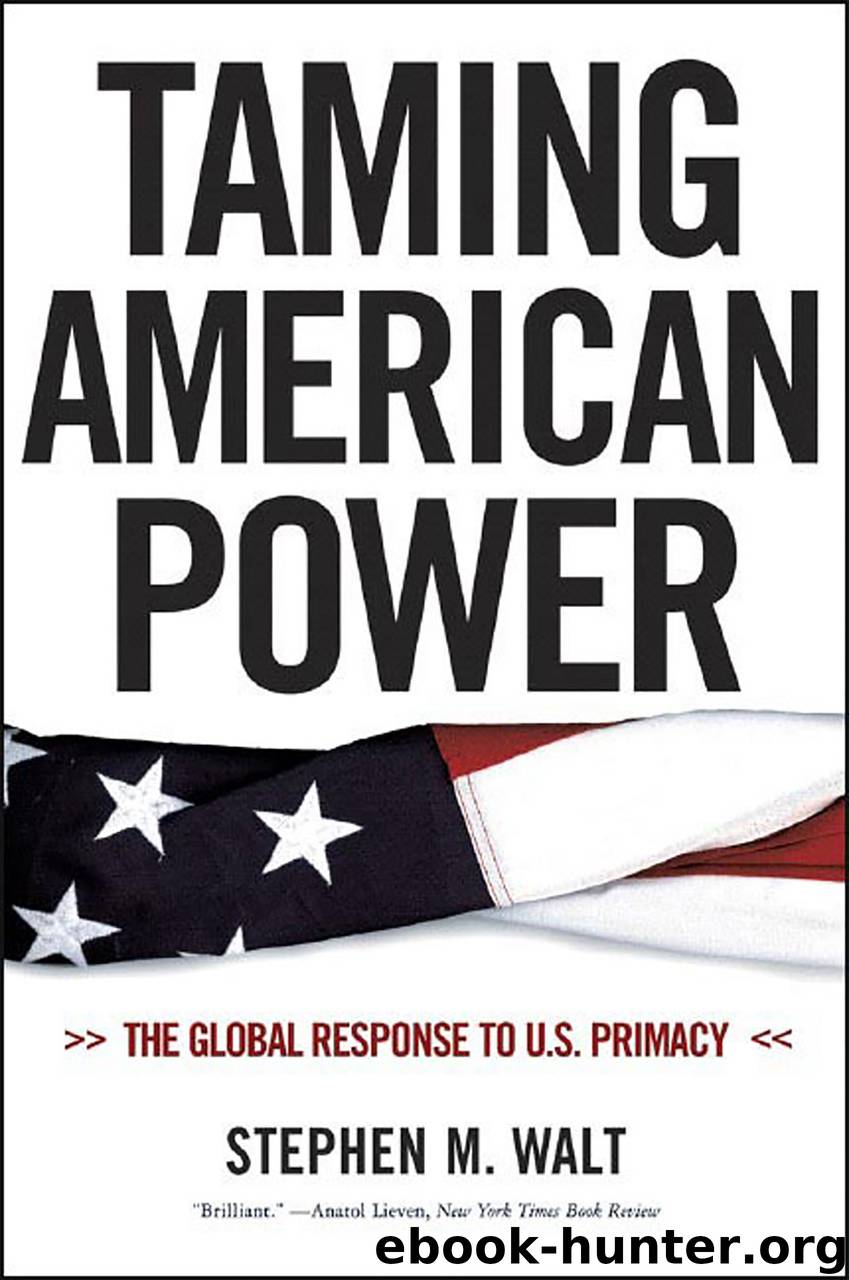
Author:Stephen M. Walt
Language: eng
Format: epub
Publisher: W. W. Norton & Company
Published: 2015-03-03T16:00:00+00:00
CHAPTER 4
STRATEGIES OF ACCOMMODATION
In chapter 1, I showed that the imbalance of power in America’s favor is historically unprecedented, and argued that U.S. leaders have used this opportunity to pursue ambitious and self-interested policies designed to enhance and extend U.S. primacy. In chapter 2, I explained why other countries regard this situation and these policies with misgivings—even when their own preferences are not directly at odds with Washington’s—and I suggested that the United States is likely to be the target of growing foreign resentment as long as it remains the dominant world power. Chapter 3 described the various strategies that states have employed to constrain or oppose U.S. primacy, even when they are no match for the United States in a direct test of strength, and warned that efforts to oppose the United States will increase if it acts in ways that threaten the interests of others.
Yet opposition is not the only way to deal with U.S. power, and both major and minor powers sometimes seem eager to accommodate the American colossus. Consider the evidence of the last fifteen years. Since the breakup of the Soviet Union in 1991, a host of former Soviet allies and satellites have actively pursued NATO membership, thereby aligning themselves formally with an alliance structure dominated by the United States. NATO’s membership grew to twenty-six nations by 2004, with several additional candidates knocking at the door. Equally striking has been the rapprochement between the United States and India—after decades of frosty relations—a process that continued despite U.S. courtship of Pakistan following the September 11 terrorist attacks.
Security ties between the United States and a number of its existing allies expanded and deepened during this same period. The United States and Japan renegotiated their security treaty in 1996, while countries such as Singapore took steps to make themselves more attractive partners and to strengthen existing security ties with the United States.1 Military-to-military contacts expanded throughout Central Asia and the Persian Gulf region (involving both traditional U.S. allies and a number of new partners), and this trend accelerated after the Bush administration declared war on al Qaeda and sought to enlist foreign governments in the campaign to root out this far-flung terrorist network. U.S. relations with several Latin American states also improved during the 1990s, reinforced by the spread of democracy in the region and a growing commitment to liberal market principles.
Relations with a number of former adversaries improved considerably as well. Although relations with Russia have been uneven, they still mark a dramatic improvement from the intense hostility of the Cold War. China and the United States remain divided over Taiwan, but they have continued to pursue mutually profitable economic ties and have avoided direct confrontation even when potential sources of tension were present.
Furthermore, concerns about U.S. power did not prevent the United States from garnering considerable international support (or at least acquiescence) on several critical foreign-policy issues. In 1990”91, the United States assembled a large and remarkably diverse coalition to oust Iraq from Kuwait. In 1999,
Download
This site does not store any files on its server. We only index and link to content provided by other sites. Please contact the content providers to delete copyright contents if any and email us, we'll remove relevant links or contents immediately.
| Arms Control | Diplomacy |
| Security | Trades & Tariffs |
| Treaties | African |
| Asian | Australian & Oceanian |
| Canadian | Caribbean & Latin American |
| European | Middle Eastern |
| Russian & Former Soviet Union |
The Secret History by Donna Tartt(18964)
The Social Justice Warrior Handbook by Lisa De Pasquale(12171)
Thirteen Reasons Why by Jay Asher(8856)
This Is How You Lose Her by Junot Diaz(6843)
Weapons of Math Destruction by Cathy O'Neil(6223)
Zero to One by Peter Thiel(5742)
Beartown by Fredrik Backman(5688)
The Myth of the Strong Leader by Archie Brown(5472)
The Fire Next Time by James Baldwin(5392)
How Democracies Die by Steven Levitsky & Daniel Ziblatt(5181)
Promise Me, Dad by Joe Biden(5118)
Stone's Rules by Roger Stone(5058)
A Higher Loyalty: Truth, Lies, and Leadership by James Comey(4919)
100 Deadly Skills by Clint Emerson(4888)
Rise and Kill First by Ronen Bergman(4744)
Secrecy World by Jake Bernstein(4709)
The David Icke Guide to the Global Conspiracy (and how to end it) by David Icke(4664)
The Farm by Tom Rob Smith(4475)
The Doomsday Machine by Daniel Ellsberg(4461)
